Os concept maps realizados na aula de segunda-feira (29/04) deverão ser publicados nos respectivos blogues e posteriormente melhorados até à próxima aula.
Bom trabalho,
pc.
Tuesday, April 30, 2013

[Book] Design Thinking
Ambrose, Gavin, & Harris, Paul; Basics Design 08: Design Thinking, AVA Publishing SA, 2009.
Monday, April 29, 2013
Representations of Gender in Advertising
This school project was created for a Women and Gender Studies class at the University of Saskatchewan by Sarah Zelinski, Kayla Hatzel and Dylan Lambi-Raine. We wanted to show how ridiculous media portrays gender roles and stereotypes in advertising through presenting gender roll reversals.
Thursday, April 25, 2013
Monday, April 22, 2013
[Book] Graphic Design Thinking
Creativity is more than an inborn talent; it is a hard-earned skill, and like any other skill, it improves with practice. Graphic Design Thinking: How to Define Problems, Get Ideas, and Create Form explores a variety of informal techniques ranging from quick, seat-of-the-pants approaches to more formal research methods for stimulating fresh thinking, and ultimately arriving at compelling and viable solutions. In the style with which author Ellen has come to been known hands-on, up-close approach to instructional design writing brainstorming techniques are grouped around the three basic phases of the design process: defining the problem, inventing ideas, and creating form.
Lupton, Ellen; Graphic Design Thinking: Beyond Brainstorming, Princeton Architectural Press, 2011.
Creating Concept Maps
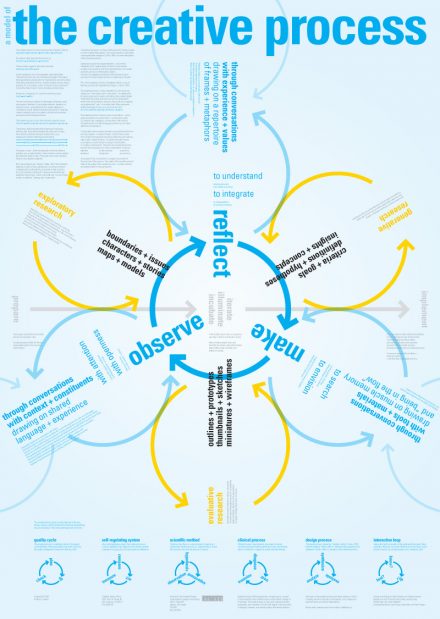
A concept map is a picture of our understanding of something. It is a diagram illustrating how sets of concepts are related. Concept maps are made up of webs of terms (nodes) related by verbs (links) to other terms (nodes). The purpose of a concept map is to represent (on a single visual plane) a person’s mental model of a concept.
At http://www.dubberly.com/concept-maps/creating-concept-maps.html.
http://www.dubberly.com/concept-mapshttp://www.dubberly.com/concept-maps/creative-process.html
http://www.dubberly.com/concept-maps/a-model-of-play.html
http://www.dubberly.com/concept-maps/innovation.html
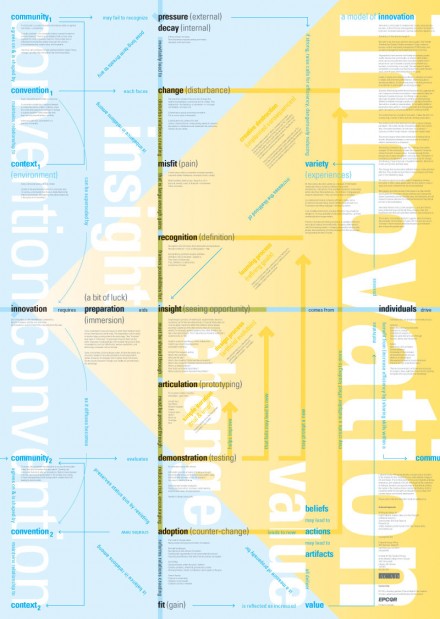
A concept map is a diagram showing the relationships among concepts. It is a graphical tool for organizing and representing knowledge.
[Book] How do you design?
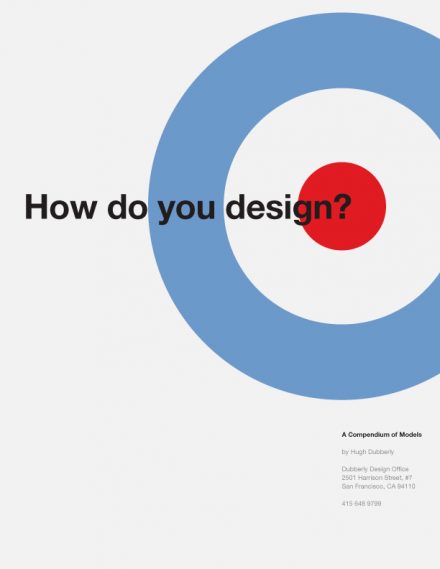
At http://www.dubberly.com/articles/how-do-you-design.html e http://www.dubberly.com/wp-content/uploads/2008/06/ddo_designprocess.pdf.Everyone designs. The teacher arranging desks for a discussion. The entrepreneur planning a business. The team building a rocket.
Their results differ. So do their goals. So do the scales of their projects and the media they use. Even their actions appear quite different. What’s similar is that they are designing. What’s similar are the processes they follow.
Thursday, April 18, 2013
Entrega P01.2
A entrega da proposta de trabalho P01.2 deverá ser efectuada por email, em formato PDF. Caso o ficheiro PDF seja maior que 10Mb recomenda-se que utilizem um serviço de filesharing. Os eventuais anexos poderão ser entregues na aula de segunda-feira (22/04) num CD/DVD devidamente organizado.
Bom trabalho,
pc.
Bom trabalho,
pc.
Tuesday, April 16, 2013
Mindmaps, (visual) brainstorming, action verbs -> blogue
Todos os grupos deverão obrigatoriamente publicar nos seus respetivos blogues os resultados dos exercícios realizados nas últimas aulas.
Bom trabalho,
pc.
Bom trabalho,
pc.
Sunday, April 14, 2013
Brainstorming —> Mindmap —> Blogue
Todos os grupos deverão publicar nos respectivos blogues os mindmaps resultantes do momento de brainstorming que ocorreu na passada aula.
Saturday, April 13, 2013
Friday, April 12, 2013
Atendimento
Hoje das 17:15 às 19:00 estarei disponível para atendimento extraordinário na Fbaup, sala 303, pav Carlos Ramos.
Bom trabalho a todos,
pc.
Bom trabalho a todos,
pc.
News!
Após dedicada ponderação, a entrega da proposta de trabalho 1.2 fica adiada/agendada para o dia 20/04/2013 até às 23:59 horas (em vez de dia 15/04), a fim de permitir que todos os grupos a consigam concluir com maior nível de sucesso.
Na próxima aula, os grupos com os quais não foi possível discutir o projeto terão prioridade no atendimento. Pede-se que preparem com devida antecedência todo o material a ser visionado.
Bom trabalho a todos,
pc.
Na próxima aula, os grupos com os quais não foi possível discutir o projeto terão prioridade no atendimento. Pede-se que preparem com devida antecedência todo o material a ser visionado.
Bom trabalho a todos,
pc.
Wednesday, April 10, 2013

Book: Ideation


Aqui poderão consultar algumas páginas do livro que levei na última aula. Contudo, creio que o poderão fazer na íntegra na Fnac.
Tuesday, April 9, 2013
About Divergent, Convergent, and Lateral Thinking
Psychologists have found that a high IQ alone does not guarantee creativity. Instead, personality traits that promote divergent thinking are more important. Divergent thinking is found among people with personality traits such as nonconformity, curiosity, willingness to take risks, and persistence.
Activities which promote divergent thinking include creating lists of questions, setting aside time for thinking and meditation, brainstorming, subject mapping / "bubble mapping", keeping a journal, creating artwork, and free writing.
At http://en.wikipedia.org/wiki/Divergent_thinking
Convergent thinking is also linked to knowledge as it involves manipulating existing knowledge by means of standard procedures. Knowledge is another important aspect of creativity. It is a source of ideas, suggests pathways to solutions, and provides criteria of effectiveness and novelty.[1] Convergent thinking is used as a tool in creative problem solving.
At http://en.wikipedia.org/wiki/Convergent_thinking
Lateral thinking is solving problems through an indirect and creative approach, using reasoning that is not immediately obvious and involving ideas that may not be obtainable by using only traditional step-by-step logic. (…) [L]ateral thinking deliberately distances itself from standard perceptions of creativity as either "vertical" logic (the classic method for problem solving: working out the solution step-by-step from the given data) or "horizontal" imagination (having a thousand ideas but being unconcerned with the detailed implementation of them).
About Mind Maps, Brainstorming
A mind map is a diagram used to visually outline information. A mind map is often created around a single word or text, placed in the center, to which associated ideas, words and concepts are added. Major categories radiate from a central node, and lesser categories are sub-branches of larger branches. Categories can represent words, ideas, tasks, or other items related to a central key word or idea.
At http://en.wikipedia.org/wiki/Mind_map
Brainstorming is a group or individual creativity technique by which efforts are made to find a conclusion for a specific problem by gathering a list of ideas spontaneously contributed by its member(s). The term was popularized by Alex Faickney Osborn in the 1953 book Applied Imagination. Osborn claimed that brainstorming was more effective than individuals working alone in generating ideas, although more recent research has questioned this conclusion. Today, the term is used as a catch all for all group ideation sessions.
Monday, April 8, 2013
General Guidelines for Conducting Research Interviews
Interviews are particularly useful for getting the story behind a participant's experiences. The interviewer can pursue in-depth information around a topic. Interviews may be useful as follow-up to certain respondents to questionnaires, e.g., to further investigate their responses. Usually open-ended questions are asked during interviews.
Before you start to design your interview questions and process, clearly articulate to yourself what problem or need is to be addressed using the information to be gathered by the interviews. This helps you keep clear focus on the intent of each question.
At http://managementhelp.org/businessresearch/interviews.htm
Basics of Conducting Focus Groups
Focus groups are a powerful means to evaluate services or test new ideas. Basically, focus groups are interviews, but of 6-10 people at the same time in the same group. One can get a great deal of information during a focus group session.
- Preparing for Session
- Developing Questions
- Planning the Session
- Facilitating Session
- Immediately After Session
Sunday, April 7, 2013
Survey —> Email processing habits and user needs
This survey aims to analyze the email processing habits and the current needs with the email.
https://docs.google.com/forms/d/1E6O99ZlSsyLa4J4Nqsi-Y5UjIUd9e6Yv-JrvLEa2JTM/viewform
Visual research methods
Visual data have been of concern to the social sciences in two ways: visual records produced by the investigator, and visual documents produced by those under study. In recent years, however, this dichotomy between the observer and the observed has begun to collapse (as it has across the qualitative social sciences more generally) and a third kind of visual record or "more accurately" representation has emerged: the collaborative representation.
Thus visual anthropology and visual sociology proceed methodologically by making visual representations (studying society by producing images), by examining pre-existing visual representations (studying images for information about society), and by collaborating with social actors in the production of visual representations.
Saturday, April 6, 2013
More on Focus Groups
This article has outlined the main features of focus group research, paying particular attention to the benefits of interaction and group dynamics which only this method can offer. Practical considerations and the time it takes to conduct focus group research may discourage many from attempting to collect data using this method. Nevertheless those who participate in this kind of research often find the experience rewarding. The process of research can be more collaborative than other forms of study, and so focus group research can be an empowering process for participants, and an exciting challenge for social researchers wanting to gain a different perspective on their field of interest.
Tuesday, April 2, 2013
About focus groups
A focus group is a form of qualitative research in which a group of people are asked about their perceptions, opinions, beliefs, and attitudes towards a product, service, concept, advertisement, idea, or packaging. Questions are asked in an interactive group setting where participants are free to talk with other group members. The first focus groups were created at the Bureau of Applied Social Research in the USA, by associate director, sociologist Robert K. Merton. The term itself was coined by psychologist and marketing expert Ernest Dichter.
Subscribe to:
Posts (Atom)