Showing posts with label txt. Show all posts

Friday, May 17, 2013

How to Give a Successful Ignite Presentation

"You will screw up when you rehearse. Don’t get frustrated. This is EXACTLY what you want. In fact, if you don’t screw up, you’re in trouble. The point of practice is to learn to recover from mistakes. So when you make a mistake, don’t start over. Continue with that rehearsal to the end of the presentation. Make adjusts and then run through the entire presentation again."
"Know Your Key Moments. Use Them as Anchors — Whether it is a joke that you’ve planned or a poignant moment when you want to move the audience, know where they are in the slides and as you practice improvisational editing, make sure you edit in a way that keep those key moments intact."
"Feel free to take the edge off a little, but you’re going to need to be sharp to be the best improvisational editor you can."
At http://userfirstweb.com/328/successful-ignite-presentations/

Giving Lightning Talks

"Remember, you're talking to an intelligent crowd here who can normally move from A to B without having to be handled through each and every step."

"One of the biggest mistakes people make about the details is misunderstanding that just because they've put something on the slides it means that they have to explain it."

"When it comes down to it there's only one way to make sure that your talk will fit in the time-slot, and that's to practice it. Read it out aloud several times. Present it to the cat. Try to convince your colleague/flatmate/significant other to listen to it."

"Preparation is everything."

"Set up and load all the apps you're going to use first — no one wants to be caught on stage in an awkward silence with nothing to say while they wait the 20 seconds it takes Mozilla to load. While you're at it don't forget to close down instant-messenger clients, calendaring apps, and anything else that might randomly pop up dialogs when you're trying to speak."

"During a lightning talk it's vital that you keep your rapport with the audience, rather than diverting your attention to the computer every slide change. Unlike a 40-minute talk, you don't have time to take breaks between slides."

"Even when you take every precaution, you'll still encounter unexpected problems. Your demo won't work. You'll discover you're using a slightly older version of the slides. Your software will use the wrong font. The computer will burst into flames and burn down the venue. Remember that you don't have time to recover from any of these problems. Even if it takes you 30 seconds to locate a new version of the slides and remember where you were, that's a tenth of your talk gone. More importantly, the audience has lost interest while you're doing this and has slipped into their daydream world where you'll have to work really hard to reacquire their attention."

At http://www.perl.com/pub/2004/07/30/lightningtalk.html.

Monday, April 22, 2013

Creating Concept Maps

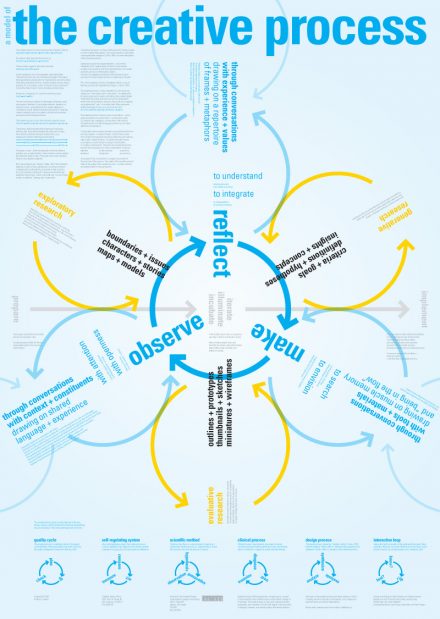
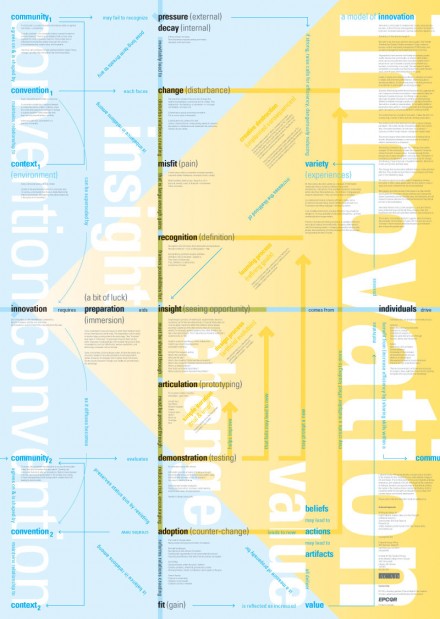
A concept map is a picture of our understanding of something. It is a diagram illustrating how sets of concepts are related. Concept maps are made up of webs of terms (nodes) related by verbs (links) to other terms (nodes). The purpose of a concept map is to represent (on a single visual plane) a person’s mental model of a concept.

At http://www.dubberly.com/concept-maps/creating-concept-maps.html.

http://www.dubberly.com/concept-maps
http://www.dubberly.com/concept-maps/creative-process.html
http://www.dubberly.com/concept-maps/a-model-of-play.html
http://www.dubberly.com/concept-maps/innovation.html

A concept map is a diagram showing the relationships among concepts. It is a graphical tool for organizing and representing knowledge.

At http://en.wikipedia.org/wiki/Concept_map

Saturday, April 13, 2013

Excerto

Podem descarregar aqui um excerto do livro A Designer's Research Manual (2009) relacionado com os métodos de pesquisa que foram enunciados nas aulas, e que aplicarão na proposta de trabalho 1.2.

Sunday, April 7, 2013

Visual research methods

Visual data have been of concern to the social sciences in two ways: visual records produced by the investigator, and visual documents produced by those under study. In recent years, however, this dichotomy between the observer and the observed has begun to collapse (as it has across the qualitative social sciences more generally) and a third kind of visual record or "more accurately" representation has emerged: the collaborative representation.

Thus visual anthropology and visual sociology proceed methodologically by making visual representations (studying society by producing images), by examining pre-existing visual representations (studying images for information about society), and by collaborating with social actors in the production of visual representations.

At http://sru.soc.surrey.ac.uk/SRU11/SRU11.html.

Saturday, April 6, 2013

More on Focus Groups

This article has outlined the main features of focus group research, paying particular attention to the benefits of interaction and group dynamics which only this method can offer. Practical considerations and the time it takes to conduct focus group research may discourage many from attempting to collect data using this method. Nevertheless those who participate in this kind of research often find the experience rewarding. The process of research can be more collaborative than other forms of study, and so focus group research can be an empowering process for participants, and an exciting challenge for social researchers wanting to gain a different perspective on their field of interest.

At http://sru.soc.surrey.ac.uk/SRU19.html.

Sunday, March 31, 2013

"Internet search engines cannot solve all research challenges."

Since design objects do not exist in a vacuum, in addition to exploring the context in which the objects reside, students must evaluate them in terms of effectiveness, consequence, and overall influence on the culture. The results are indeed "object lessons" that serve as building blocks of critical design writing.
At http://www.theatlantic.com/health/archive/2011/06/why-google-will-never-beat-old-fashioned-design-research/240566/

Monday, March 11, 2013

Shaping Belief: The role of audience in visual communication

The designer, of course, cannot combine just any set of beliefs with a subject to reach the communication goal. Communication is directed toward a specific audience and that audience comes to the argument with particular cultural beliefs and understanding.
At TYLER, Ann C., Shaping Belief: The role of audience in visual communication, 1992.

Friday, March 8, 2013

More on design briefs

Your design can only be as good as the brief you worked from. The best projects are borne from creative briefs that are open enough to inspire ideas, while being specific enough to feel workable.

At http://freelanceswitch.com/clients/the-ultimate-design-brief/

As a designer it is important to have a template such as this one to give to clients as clients will not always come to you with a design brief – feel free to use this one as you please. By having a template ready, it shows them your professionalism and ultimately saves them (and you) a lot of time and money.

At http://justcreative.com/2008/09/26/how-to-write-an-effective-design-brief/

How do you write a design brief?—David Airey


Any graphic design project needs a detailed design brief. There are two main reasons:
  • It ensures the client knows exactly what s/he wants to achieve from the project.
  • It acts as a point of reference for designers, forming the focus of their work.

At http://www.davidairey.com/how-do-you-write-a-graphic-design-brief/

Tuesday, March 5, 2013

7 Basics to Create a Good Design Brief

The design brief serves as the guiding document for the project. Think of it as like a business plan for a specific project. It should cover everything necessary to the project, in a manner that is easy to refer to throughout the project timeline.

Make notes on your design briefs once you start the project. Keep your proposal along with it, as well as other important documents. Highlight the important parts of each, or make notes in the margins. Don’t just look it over at the beginning and then file it away somewhere. Effectively using a design brief throughout the process can result in a much better end result.

At http://www.webdesignerdepot.com/2011/03/7-basics-to-create-a-good-design-brief/.

Sunday, February 24, 2013

Graphic Design: Fine Art or Social Science

Graphic designers are always in need of active dialogue with their clients and with other professionals (…) to really make the best of their practice. This certainly has important implications in relation to the evaluation of graphic design quality and to the education of graphic designers.
At FRASCARA, Jorge; Graphic Design: Fine Art or Social Science; 1988.

Monday, February 18, 2013

Better Skills through Better Research

Research is not, however, some pedagogic make-work or punishment. It is rather a necessary dimension in undergraduate and graduate programs. (…) Nonetheless, research in the design discipline has also traditionally been something of a bugaboo. While appreciating its value in certain circumstances, designers realize it has proven to be double-edged sword. (…) The fact is graphic design, indeed all design, is not produced in a vacuum. If the correct structures are in place, outside influences must be considered and also prevail.
At HELLER, Steven; Better Skills through Better Research; 2006.